Bugg Spring
Bugg Spring
Summary
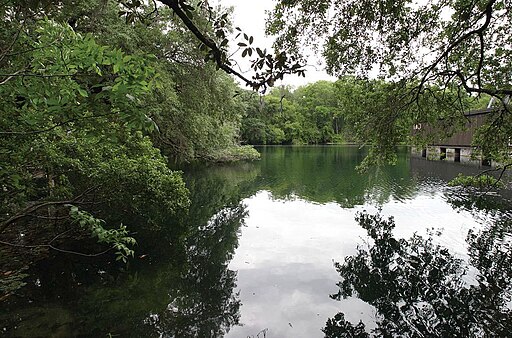
Bugg Spring is one of Lake County’s most mysterious and historically significant springs. Located near Okahumpka, this second-magnitude spring forms a deep, nearly vertical-walled pool approximately 400 feet in diameter and plunges to depths of 170 to 175 feet.
Today, the spring sits on private property owned by the U.S. Navy and is not open to the public. While it is no longer accessible for recreation, Bugg Spring holds a remarkable geological, archaeological, and military history that sets it apart from other springs in the region.
The Spring Basin and Geology
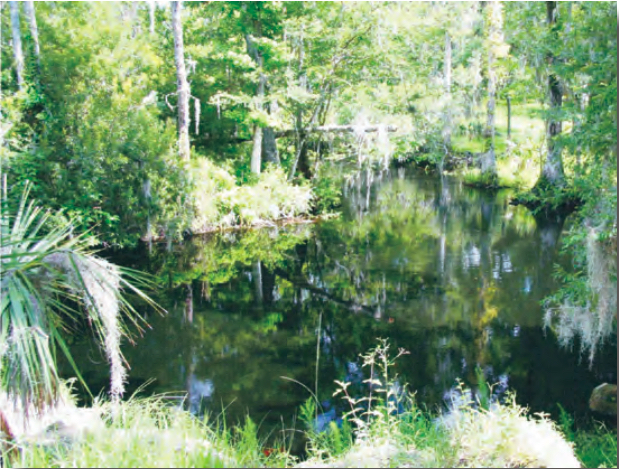
Bugg Spring forms a large circular pool covering roughly 2.4 acres at the surface. Except along the western side, the pool walls drop almost vertically, creating a steep-sided basin that tapers to about half an acre at the bottom of the central cavity.
Depth measurements taken in the 1940s recorded depths of approximately 176 feet. The bottom slopes gradually from the banks to the rim of an elliptical cavity at about 55 feet deep before plunging further. Because of the depth of the spring opening, no surface boil is visible.
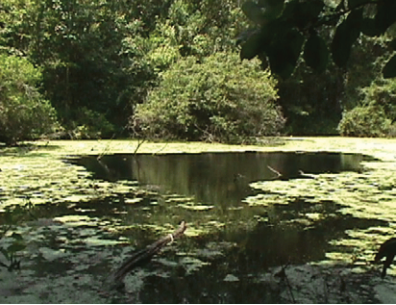
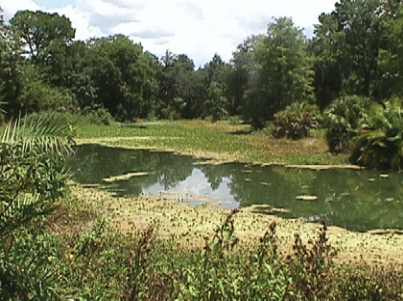
Unlike many sand-bottom Florida springs, Bugg Spring contains little aquatic vegetation. Algae are present within the pool and along the spring run. Several limestone formations are exposed in the basin walls, including about 40 feet of Avon Park limestone — one of the oldest exposed limestone layers in the area. Fossils such as echinoderms, mollusks, and macro foraminifera have been documented in the limestone walls.
Bugg Spring discharges northward through Bugg Spring Run for approximately 0.8 to 1 mile before joining Helena Run, which flows into Lake Denham and eventually Lake Harris.
Location and Surroundings
Bugg Spring lies within the Ocklawaha River Watershed near the historic community of Okahumpka. The spring is mostly surrounded by low-lying swampland, with sandhill terrain rising to the south.
The surrounding property totals roughly 68 to 69 acres. Originally purchased by the Branham family in 1923, the land remained in private ownership for decades before being leased to the U.S. Navy in 1956. The Navy later purchased the entire property in 2011–2012.
Today, the spring is part of the Naval Undersea Warfare Center’s Underwater Sound Reference Division facility. The site has been used for sonar and underwater acoustics research for decades.
Public Access
Bugg Spring is private property and is not open to the public. The spring pool and portions of the spring run are fenced. There are no public viewing areas, trails, or designated access points.
A Name Rooted in Legend
The name “Okahumpka” derives from the Native word “Okeehumpkee,” meaning “Deep Waters,” a reference to the remarkable depth of the spring near the historic town of Old Okahumpka.
The name “Bugg Spring” is commonly attributed to a local legend involving a boy named Billy Bugg who drowned in the spring more than a century ago. Stories passed down through generations claim that a mule and wagon once fell into the seemingly bottomless waters. Over time, the spring’s great depth gave rise to superstitions and folklore about its mysterious bottom.
Depth readings in 1943 helped dispel the myth of a bottomless spring, but the sense of mystery remains part of its character.
Archaeological and Seminole History
Long before modern settlement, the area around Bugg Spring was home to Native American communities. Archaeological investigations revealed evidence that Indigenous people used the spring area for thousands of years. The site is associated with the Seminole town of Okahumpka, which played an important role during the period leading up to the Second Seminole War.
Warriors from the region are believed to have taken part in Dade’s Battle in 1835. Though the precise village location is debated, the spring sits within an area of significant Seminole history.
J. J. Dickison and the “Swamp Fox”
Following the Civil War, the property surrounding Bugg Spring became home to Confederate Colonel J. J. Dickison. Known as the “Swamp Fox” of the Confederacy for his guerrilla-style tactics, Dickison led raids across East and Central Florida during the war. Among his notable actions was the ambush and capture of the Union steamboat Columbine on the St. Johns River.
The presence of Dickison at Bugg Spring adds another layer of historical importance to the site.
Military Research Era
Beginning in 1956, portions of the property were leased to the U.S. Navy for underwater sound research. The deep, clear, and stable water conditions made Bugg Spring ideal for sonar testing and acoustic measurement. In 2011–2012, the Navy purchased the property outright and continues to use the site for specialized research operations.
The fencing of the spring run, according to local accounts, has helped preserve the spring’s relatively natural condition.
Why Bugg Spring Matters
Bugg Spring is not a recreational swimming hole or a public park. Its importance lies in its geology, depth, archaeological heritage, Civil War history, and modern scientific use. Few springs in Florida combine so many layers of history in one location.
Though visitors cannot access the spring itself, Bugg Spring remains one of Lake County’s most intriguing natural landmarks — a deep, quiet pool that has witnessed centuries of Florida history.
Resources & References:
- Facebook Page
- St Johns Water River Management District
- The History of Bugg Springs (News Article)
- Interesting read from ExploreSouthernHistory.com
- Wikipedia
Nearby Springs
Photo: State of Florida, photo by T. Scott, Public domain, via Wikimedia Commons
Sorry, no records were found. Please adjust your search criteria and try again.
Sorry, unable to load the Maps API.
Nearby Springs