Darby Spring
Darby Spring
Darby Spring is a small, privately owned spring on the south bank of the Santa Fe River near High Springs, Florida. Although it is not a developed recreation destination, the spring has unusual geological and archaeological significance. Excavations conducted more than 70 years ago uncovered pottery, projectile points, knives, scrapers, and other evidence showing that people used the area for thousands of years.
The spring is located approximately 1.8 miles north of High Springs and about 0.1 mile upstream from the public boat ramp near the US 441 bridge. Because Darby Spring is on private property, it should not be approached from land without the owner’s permission.
The Spring
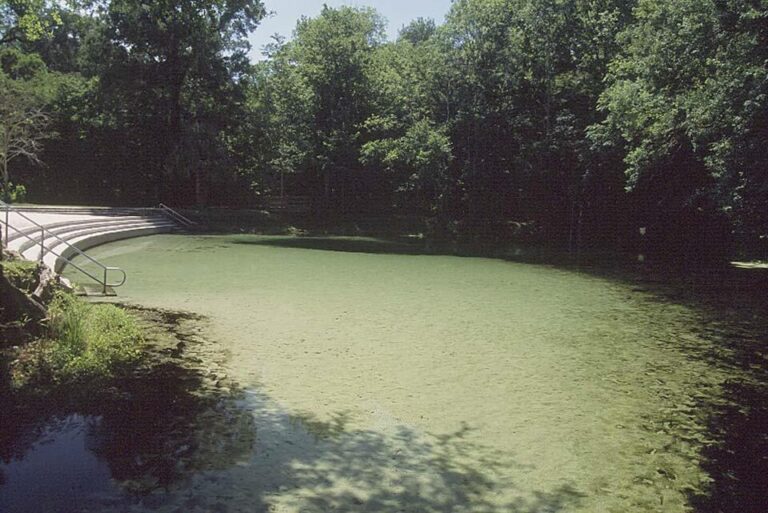
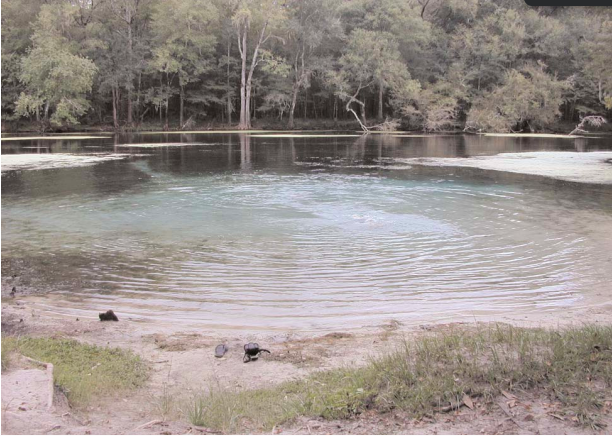
According to a Florida Geological Survey description based on a December 2002 visit, the Darby Spring pool measured approximately 40 feet across and 10 feet deep.
At the time of that survey, aquatic vegetation and duckweed covered much of the pool. The surveyors could not clearly see the pool bottom or identify the spring vent. They also reported that the spring was not flowing and that its run contained stagnant water.
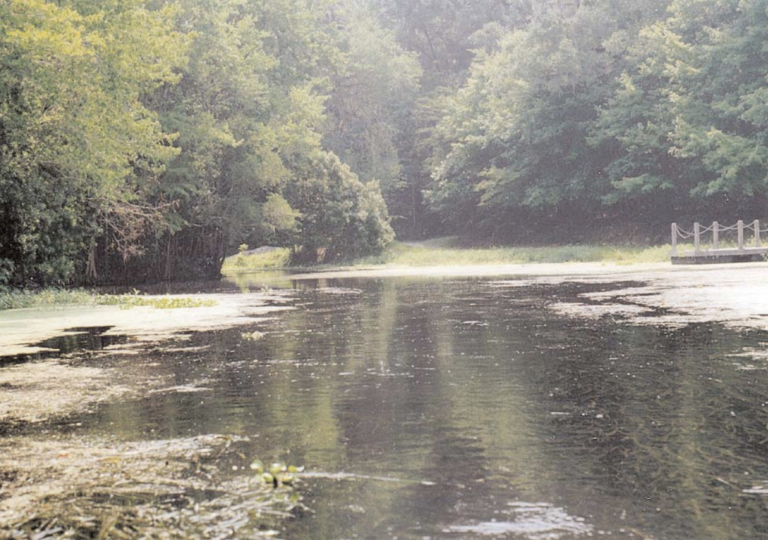
The spring run was measured at approximately 150 feet long, 4 feet wide, and only about 6 inches deep. Its bottom consisted of soft organic material covered with leaves and tree branches.
Geology of Darby Spring
Darby Spring lies in a karst landscape shaped by water moving through soluble limestone.
A 1961 Florida Geological Survey investigation described Darby and nearby Hornsby Springs as examples of artesian groundwater discharge. In this part of Alachua County, porous limestone lies relatively close to the surface. Slightly acidic groundwater gradually dissolves the rock, creating springs, sinkholes, cavities, and underground channels.
The report identified the underlying rock as limestone of the Crystal River Formation within the Ocala Group. Researchers noted that the area around High Springs contains numerous solution features formed as groundwater moved through and enlarged openings in the limestone.
Evidence around Darby and Hornsby Springs suggested that both springs once occupied larger springheads than they did when researchers examined them in the 1950s. Freshwater deposits found above the observed water level indicated that groundwater had previously stood several feet higher.
This history may help explain why Darby Spring was described in 2002 as shallow, heavily vegetated, and inactive rather than as a clear, strongly flowing spring.
A Modified Spring Landscape
The landscape around Darby Spring has also been altered by people.
The 1961 investigation described a canal that had been dug in an attempt to divert water from the Hornsby Springs system toward Darby Spring. A historical site map shows Darby Spring beside the Santa Fe River, the artificial canal extending eastward, and the locations of archaeological excavations performed in 1951 and 1952.
The canal and other land disturbance complicate efforts to understand the spring’s original hydrology. Researchers also reported that bulldozing and soil removal had disturbed parts of the archaeological site before it could be fully studied.
Archaeological Excavations at Darby Spring
Darby Spring is best known for its archaeological importance.
In 1951 and 1952, the Florida Geological Survey sponsored excavations at Darby Spring and nearby Hornsby Springs. The investigators recovered extensive quantities of chipped stone, pottery fragments, tools, and other artifacts. Their findings indicated that people returned to the spring area over a very long period.
The ground around Darby Spring contained large numbers of stone chips and flakes, suggesting that people made or repaired tools at the site. The researchers described parts of the area as an extensive lithic workshop, although later bulldozing had damaged the original arrangement of some materials.
Artifacts associated with Darby Spring included:
- Projectile points
- Stone knives
- Flake scrapers
- Turtleback scrapers
- Worked stone fragments
- Plain and incised pottery
The report documents several knives and scrapers recovered from Darby Spring excavation pits at depths ranging from approximately 6 to 42 inches. One artifact plate identifies two unclassified knife forms, a flake scraper, and multiple turtleback scrapers found at the site.
Researchers also recorded numerous knife forms in the Darby Spring collection, including ovoid knives, stemmed knives, small bifacial knives, and flake knives.
Evidence of Thousands of Years of Human Activity
The artifacts found at Darby Spring appear to represent multiple periods of Florida’s early human history.
In the deeper excavation levels, researchers found projectile-point styles associated with early hunting cultures. Above them were later points and eventually fiber-tempered pottery. The investigators interpreted this sequence as evidence of occupation extending from the Paleo-Indian period through the Archaic period and into later ceramic traditions.
Using artifact types and dates established at comparable sites, the report proposed the following general sequence:
- Suwannee points: approximately 9,000–7,000 BC
- Bolen points: approximately 7,000–5,000 BC
- Plain fiber-tempered pottery: approximately 2,000–1,500 BC
- Orange Incised pottery: approximately 1,500–1,000 BC
Orange Incised pottery was recovered from Darby Spring at depths of 6–12 inches and 12–18 inches.
The study also recorded small quantities of later pottery, including pieces interpreted as possible Tchefuncte Plain, grit-tempered plain pottery, and Lochloosa Punctated.
Because parts of the site had been disturbed, the researchers cautioned that not every artifact retained a clear archaeological context. However, intact portions of the excavation still preserved a meaningful sequence showing that people used the spring vicinity repeatedly across thousands of years.
Was Darby Spring Radiocarbon Dated?
The excavation report includes a radiocarbon date of approximately 9,880 ± 270 years, but that sample came from nearby Hornsby Springs rather than directly from Darby Spring.
The investigators used the radiocarbon result, together with similarities in artifact types and stratigraphy, to help interpret the early sequence at both sites. It would therefore be inaccurate to say that Darby Spring itself received that radiocarbon date. Instead, the findings suggest that activity at Darby Spring may extend back roughly 9,000 years or more.
Why Was the Spring Important?
The report does not reveal exactly how every generation used Darby Spring, but the setting would have offered several advantages.
The spring and nearby Santa Fe River provided freshwater, fish, shellfish, plants, and access through the surrounding landscape. The presence of many stone flakes and unfinished or discarded tools indicates that people also manufactured and maintained stone implements near the spring.
Rather than representing a single campsite, Darby Spring appears to have been a place that different groups visited or occupied repeatedly over a long period.
Can You Visit Darby Spring?
Darby Spring is located on wooded private property and is not a public swimming hole, park, or developed recreation site. Visitors should not cross private land or attempt to reach the spring without permission.
The nearby High Springs Boat Ramp provides public access to the Santa Fe River close to the spring, but use of the boat ramp does not grant access to the private spring property. Anyone passing the area by water should respect property boundaries and avoid disturbing the spring or archaeological site.
Darby Spring Today
Little publicly available information describes the spring’s present condition. The Florida Geological Survey’s 2002 observations remain one of the most detailed physical descriptions, while later databases identify Darby Spring as a recognized monitoring location.
Darby Spring may not have the powerful flow or recreational appeal of better-known springs along the Santa Fe River. Its importance lies instead in the story preserved around it: a changing karst spring, a landscape altered by groundwater and human activity, and an archaeological record spanning thousands of years.
Resources
- An investigation of the Darby and Hornsby Springs sites, Alachua County, Florida, by Edward M. Dolan and Glenn T. Allen, Jr. Link
- Darby Springs water quality site
Photo: Florida Geological Survey, Bulletin No. 66
Sorry, no records were found. Please adjust your search criteria and try again.
Sorry, unable to load the Maps API.
Nearby Springs