Boulware Springs Nature Park
Boulware Springs Nature Park
Summary
Boulware Springs Nature Park is a 106-acre historic park in Gainesville, Florida, centered on a natural spring and the city’s former municipal waterworks. The site played an important role in the selection of Gainesville as the Alachua County seat and later supplied the city’s first public water system.
Today, visitors can view the historic spring basin and waterworks building, explore the surrounding natural area, enjoy a picnic, and access the Gainesville–Hawthorne State Trail. Although Boulware Spring is not open for swimming or wading, it remains one of Gainesville’s most historically significant natural landmarks.
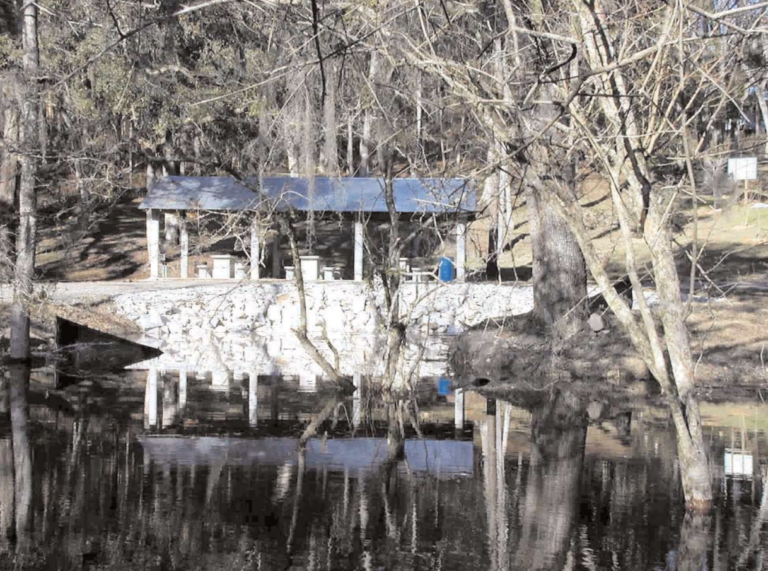
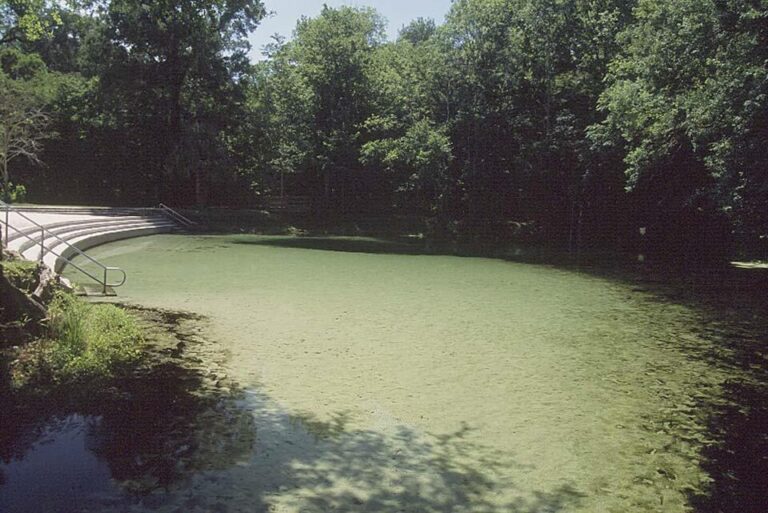
Boulware Spring itself is a fourth-magnitude freshwater spring that emerges into a shallow, brick-lined, semicircular basin beside the historic waterworks building. The basin covers approximately 430 square feet, and the spring is fed by a local intermediate aquifer.
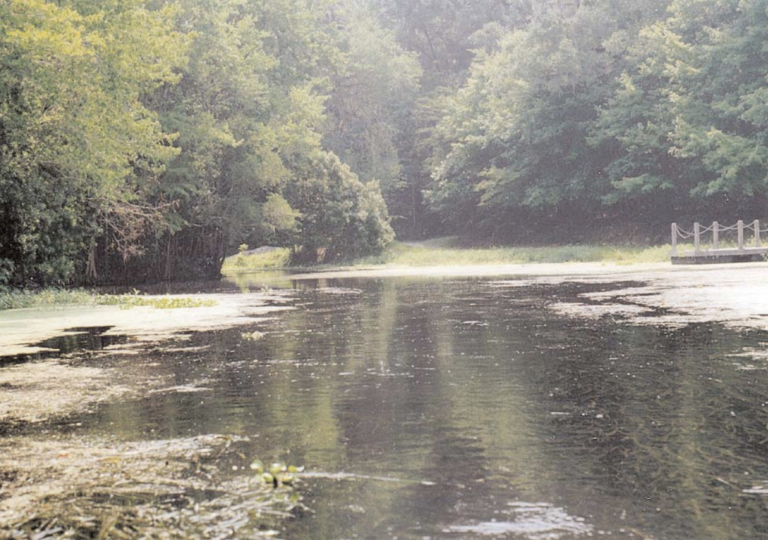
Water flows beneath a walkway from the spring basin into a larger rectangular pool measuring approximately 70 feet long, 24 feet wide, and about five feet deep. It then leaves the pool and follows a wooded ravine toward Paynes Prairie.
The City of Gainesville has estimated the spring’s discharge at approximately 194,000 gallons per day. During a May 2022 measurement, the Alachua County Environmental Protection Department recorded a flow of approximately 284,000 gallons per day. Spring flow can vary with rainfall, groundwater levels, and other local hydrologic conditions.
Swimming and wading are not permitted in the spring basin or adjoining pool. Boulware Springs is primarily a place to experience local history, nature, and trail access rather than a recreational swimming spring.
History of Boulware Springs
Early Human History
People have gathered near Boulware Springs for centuries. Its dependable freshwater flow and location along the northern edge of Paynes Prairie made the area attractive to Florida’s Indigenous peoples.
Archaeological investigations have identified prehistoric sites within the property, although the entire area had not been comprehensively surveyed when the Boulware Springs Waterworks was nominated for the National Register of Historic Places. The spring’s archaeological significance shows that its history began long before the construction of Gainesville or its municipal water system.
The “Birthplace of Gainesville”
Boulware Springs is sometimes called the birthplace of Gainesville because of a public meeting held near the spring during the early 1850s.
At the time, Newnansville was the Alachua County seat. As transportation routes and settlement patterns changed, county residents considered establishing a new, more centrally located seat of government. According to the National Register nomination, citizens assembled at Boulware Springs in 1853 and selected the community that became Gainesville as the new county seat.
Some later local accounts date the gathering to 1854, so visitors may encounter both years in descriptions of the site. The National Register documentation and the City of Gainesville’s current renovation information use 1853.
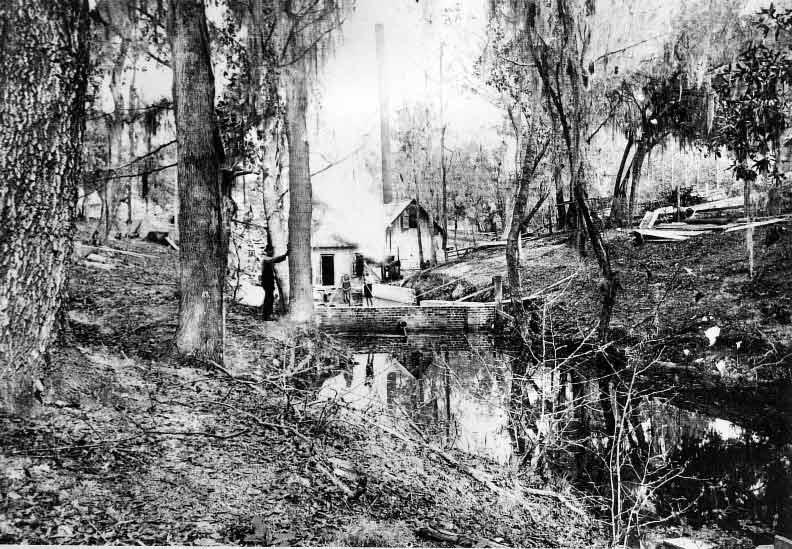
Boulware Spring in the late 19th century. Photo credit.
Gainesville Builds a Public Water System
By the late 19th century, Gainesville needed a dependable water supply for its growing population and for protection against fires. The city purchased approximately 30 acres surrounding Boulware Springs from the Jackson family in 1891 for $2,500.
The spring was named for the Boulware family, prominent local landowners before the Civil War. Much of their property later passed to the Jackson family.
City voters narrowly approved the issuance of $50,000 in bonds to construct a central water system. Maps from 1892 show that the waterworks was already under construction, and local newspaper reports indicate that the city was preparing to test and staff the plant by 1894.
The Original Boulware Springs Waterworks
The first waterworks building was a relatively simple brick structure with separate spaces for pumping equipment and a steam boiler. Wood was burned to produce steam, which powered the pumps that moved water from Boulware Springs toward Gainesville.
The pumping station stood approximately two miles from the center of town. Water traveled through an eight-inch main, supplying homes and businesses while also creating pressure for firefighting.
An 1897 description claimed that the spring could provide as much as one million gallons in 24 hours and could replace the water faster than the plant could pump it. That figure was a historical estimate and should not be directly compared with modern flow measurements, which use different methods and reflect present-day conditions.
The waterworks was considered a major civic achievement. A promotional publication from 1898 praised the plant as one of the finest in Florida and presented the spring’s water as an important asset for Gainesville’s future growth.
Construction of the Surviving Building
As Gainesville grew, the original facility was no longer large enough. A larger brick building was constructed around 1905, and an additional room was added around 1908. Parts of the earlier pump room were incorporated into the expanded facility.
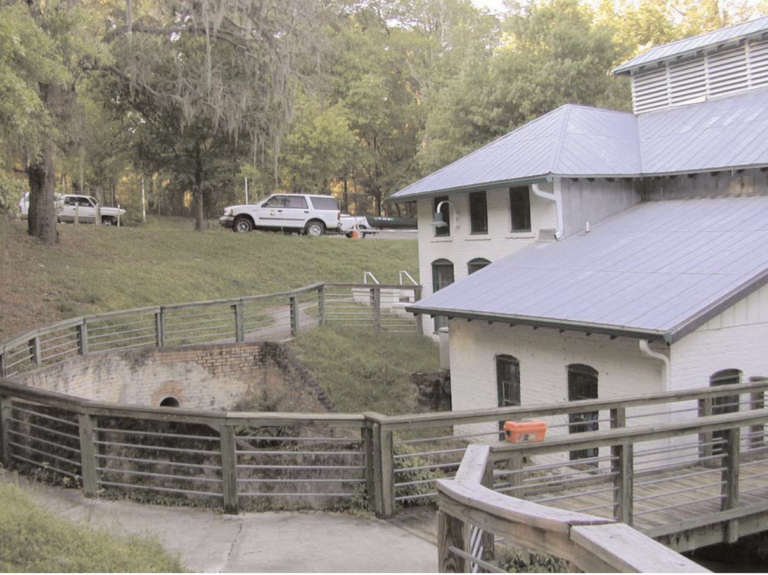
The surviving waterworks is a notable example of early industrial architecture. Its features include painted brick walls, arched door and window openings, a standing-seam metal roof, and a large louvered roof ventilator above the former boiler room.
The building was constructed immediately beside the spring reservoir, visually connecting Gainesville’s early municipal engineering system with the natural water source that made it possible.
Boulware Springs and the University of Florida
Boulware Springs also played a role in Gainesville’s successful effort to become the home of the University of Florida.
When Gainesville competed with Lake City for the state university in 1905, the city offered several incentives. One was a promise to provide the university with free water through the municipal system supplied by Boulware Springs.
The National Register nomination describes that offer as an important factor in the decision to relocate the university from Lake City to Gainesville. The university opened at its Gainesville campus in 1906 and became one of the most influential institutions in the city’s subsequent development.
The End of the Spring-Fed Municipal System
By 1905, Gainesville’s increasing demand for water had begun to raise concerns about whether Boulware Springs could continue to supply the entire city. Additional spring flow was tapped, and an artesian well was drilled on the hill near the spring.
Nevertheless, Gainesville eventually developed a new municipal water source. Boulware Springs stopped serving as the city’s primary water utility in 1913.
The waterworks was converted from steam-powered machinery to electric pumps sometime between 1908 and 1922. Although it was no longer Gainesville’s main water source, the spring continued to serve an auxiliary role. Water from Boulware Springs was supplied to the city’s Kelly Power Plant for boiler use until 1977.
Historic Preservation
The Boulware Springs Waterworks was added to the National Register of Historic Places on June 20, 1985. Its designation recognizes both the building’s industrial architecture and the site’s influence on Gainesville’s founding, water system, and growth.
The facility underwent a major renovation in 1990, and the property became a public historic park and recreational trailhead. The waterworks has also been designated an American Water Works Landmark.
The setting remains unusual because it preserves a natural spring, a historic municipal utility, archaeological resources, and a public recreation area in one location.
Planned Waterworks Renovation
The City of Gainesville is planning another major renovation of the Boulware Springs Waterworks and surrounding trailhead.
The proposed project includes:
- Renovation of the historic waterworks building
- A new trailhead restroom
- A redesigned parking area
- Site lighting
- A pavilion
- Landscaping
- Site-stabilization improvements
The project is intended to preserve the historic building while improving public access and protecting the environmentally sensitive spring and surrounding landscape.
The city hired Jones Edmunds & Associates in 2022 to lead the planning process. Preliminary work included topographic and utility surveys, geotechnical investigations, wetland delineation, and other technical studies. A public open house was held in January 2023, and the final master plan was completed in April 2023.
As of July 2026, the city reports that the project is expected to enter redesign in fall 2026, with construction potentially beginning as early as fall 2027. The schedule and project details may change as plans are refined and the site undergoes additional environmental review.
What to Expect
Boulware Springs is best suited to visitors interested in local history, walking, cycling, wildlife, and access to the Gainesville–Hawthorne State Trail.
The spring occupies a constructed basin immediately beside the old waterworks. Visitors can view the water and the exterior of the historic building, but swimming and wading are prohibited. The site therefore feels different from recreational Florida springs developed for tubing or swimming.
The surrounding park includes wooded areas, picnic facilities, walking paths, and habitat for birds and other wildlife. The City of Gainesville is also restoring degraded sandhill and upland pine habitat north of the parking area.
Because renovation work is planned, access to individual buildings, restrooms, parking areas, or parts of the property may change. Check current city notices and posted signs before visiting.
Gainesville–Hawthorne State Trail
Boulware Springs serves as the Gainesville trailhead for the paved Gainesville–Hawthorne State Trail. The trail extends approximately 16 miles between Gainesville and Hawthorne, although it is sometimes described locally as a 17-mile trail.
The route passes through conservation lands associated with Paynes Prairie and follows part of a former railroad corridor. It is open to walkers, runners, cyclists, and horseback riders. A grassy equestrian trail parallels portions of the paved route.
Visitors should note that the trail system and Boulware Springs Nature Park are managed by different government agencies and may publish slightly different operating hours. The City of Gainesville’s posted hours should be followed for access to the Boulware Springs park property.
Activities
- Hiking
- Nature walks
- Trail running
- Biking
- Horseback riding along the state trail
- Wildlife viewing
- Birdwatching
- Picnicking
- Historic sightseeing
- Photography
Amenities
- Walking trails and paths
- Bicycle paths
- Access to the Gainesville–Hawthorne State Trail
- Picnic tables
- Grills
- Restrooms
- Parking
- Historic waterworks building
- Spring overlook and interpretive features
- Accessible park features
- Horse-unloading area
The City of Gainesville lists the park as accessible, although accessibility may vary among natural-surface areas and may be affected by future construction.
Park Hours
March 15–September 30:
7 a.m.–8 p.m. daily
October 1–March 14:
7 a.m.–6 p.m. daily
Hours can change because of weather, maintenance, renovation work, or other conditions. Follow posted signs and current City of Gainesville notices.
Entrance Fees
Admission to Boulware Springs Nature Park is free.
No entrance fee is required to use the Gainesville–Hawthorne State Trail.
Pet Policy
Dogs are welcome but must remain on a leash. Owners should clean up after their animals and keep them on established paths where required.
Park Rules
Boulware Springs is a protected natural and historic site. Visitors should remain on established trails and avoid disturbing plants, wildlife, archaeological materials, or historic structures.
Swimming and wading in the spring are prohibited. Camping, fires, digging, and unauthorized motorized vehicles are also prohibited within the natural area.
Address
Boulware Springs Nature Park
3300 SE 15th Street
Gainesville, FL 32641
The adjoining Gainesville–Hawthorne State Trail trailhead may appear under 3400 SE 15th Street in state park information. Visitors may therefore encounter both addresses when planning a trip.
Frequently Asked Questions
Can you swim at Boulware Springs?
No. Swimming and wading are not permitted in the spring basin or the adjoining constructed pool. Boulware Springs is a historic site and nature park rather than a developed swimming spring.
Can you see the spring?
Yes. Visitors can view the spring basin and the larger pool beside the historic waterworks. Access to particular viewing areas may occasionally be affected by maintenance or renovation work.
Why is Boulware Springs historically important?
The site is connected with the selection of Gainesville as the Alachua County seat, the development of Gainesville’s first municipal water system, and the city’s successful campaign to become the home of the University of Florida.
Was Boulware Springs Gainesville’s first water supply?
It supplied Gainesville’s first central municipal waterworks. The city purchased the property in 1891, and the water system was under development by 1892. Boulware Springs remained Gainesville’s primary municipal water source until 1913 and continued serving auxiliary utility functions until 1977.
When was the Boulware Springs Waterworks built?
The first pumping facility was constructed during the early 1890s. The larger surviving building was constructed around 1905 and expanded around 1908. Portions of the earlier pump room were incorporated into the later structure.
Is the historic waterworks building open?
Access to the interior may be limited, particularly while the city prepares for renovation. Visitors should not assume that the building will be open and should check current city information before visiting specifically to see the interior.
Where does the spring water go?
Water leaves the constructed pool and flows through a ravine toward Paynes Prairie. Boulware Springs is therefore part of the broader Paynes Prairie watershed.
How much water does Boulware Spring produce?
The City of Gainesville has estimated its flow at approximately 194,000 gallons per day. Alachua County measured approximately 284,000 gallons per day in May 2022. Discharge varies over time, so these figures should be treated as estimates or individual measurements rather than a fixed daily output.
How large is Boulware Springs Nature Park?
The City of Gainesville identifies the park as approximately 106 acres.
Is Boulware Springs the beginning of the Gainesville–Hawthorne State Trail?
Yes. Boulware Springs is the Gainesville trailhead and western end of the Gainesville–Hawthorne State Trail. The paved route continues through conservation lands toward Hawthorne.
Are dogs allowed?
Yes. Dogs are permitted when kept on a leash.
Is parking available?
Yes. Parking is available at the park and trailhead. Separate entrances or parking areas may be used for the historic park and state trail, and access may change during the planned renovation.
Resources
Photos:
Florida Geological Survey, Bulletin No. 66
Boulware Spring in Gainesville, Florida the late 19th century