Indian Spring
Indian Spring
Overview
Indian Spring is a fascinating and somewhat lesser-known spring in southern Wakulla County, notable not only for its attractive spring pool but also for its importance within the broader Wakulla cave system. The spring is located on private property near the former Camp Indian Springs area, west of Edward Ball Wakulla Springs State Park, and is not a typical public recreation stop.
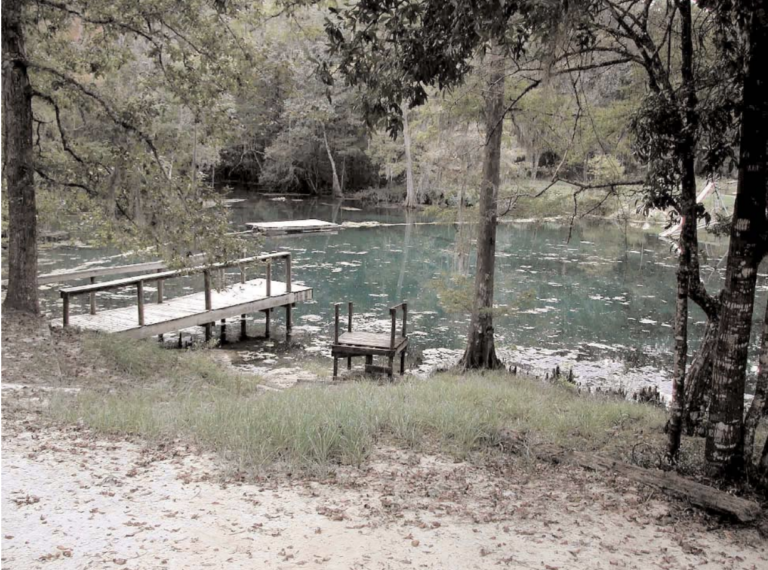
At the surface, Indian Spring appears as a beautiful circular pool with clear water and a greenish tint, surrounded by forest and long associated with a camp setting. Beneath the surface, however, the spring is part of a much larger underground karst network.
Location and Setting
Indian Spring is located south of Tallahassee, west of Edward Ball Wakulla Springs State Park, near the former Camp Indian Springs property. The spring is not a public recreation site, and the surrounding land appears to be privately owned.
Older geological descriptions identify the spring with YMCA Camp Indian Springs, which was built around the spring pool and used the area as a summer recreation setting. However, the YMCA’s Tallahassee presence later changed, and more recent references describe the former camp property as Sherlock Springs. Because of that, it is safer to describe Indian Spring as a privately situated spring historically associated with Camp Indian Springs, rather than as a currently YMCA-owned property.
Although Indian Spring is often discussed in connection with Wakulla Springs State Park, it is not itself a public spring inside the park. Instead, it lies nearby within the same broader karst region and is hydrologically connected to the larger Wakulla system.
Description
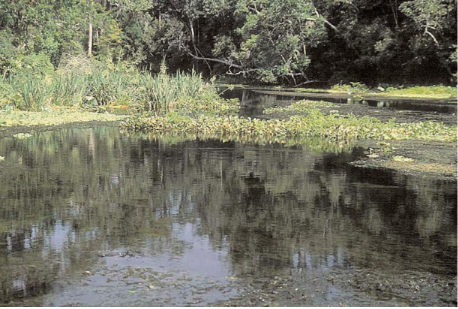
Indian Spring has been described as a circular spring pool about 185 feet in diameter and roughly 30 feet deep. The water is typically clear with a greenish tint, and the spring has a distinctly attractive appearance at the surface.
A large semicircular limestone cave is located along the north side of the pool. This is one of the most important features of the spring. While Indian Spring may not have the dramatic surface outflow of a place like Wakulla Spring, it has long been recognized as having substantial significance underground.
The spring run is relatively short, flowing about 0.7 miles southeast toward Sally Ward Spring and the headwaters of the Wakulla River. This helps place Indian Spring within a much larger hydrologic story: it is not an isolated pool, but part of a connected spring and cave system.
Cave Diving and the Wakulla System
One of the main reasons Indian Spring is so notable is its role in the Wakulla / Woodville Karst Plain cave system. The visible spring pool is only part of the story. Beneath it lies a significant submerged conduit system tied to one of Florida’s most important karst regions.
This makes Indian Spring especially interesting for readers who enjoy the geology of Florida springs. It is a reminder that some springs that appear modest at the surface may have major underground importance.
At the same time, this is not a casual dive site. Cave diving here is highly specialized, and the spring’s significance in that world should be understood in the context of expert exploration, technical training, restricted access, and serious risk. Indian Spring is actually remembered within the cave-diving community because of a 1991 cave-diving accident associated with the site.
Final Thoughts
Indian Spring is one of those Florida springs that becomes more interesting the more you learn about it. On the surface, it is an attractive spring pool in a wooded private setting. Below the surface, it is part of a much larger and more important underground system that has made it well known in cave-diving and karst circles.
Because the spring is privately situated and closely associated with technical cave exploration, most visitors will encounter Indian Spring through maps, historical accounts, geological descriptions, and cave-diving resources rather than through a typical public park experience.
More Resources
- Cave Atlas
- Florida Caves
- Extreme Exposure (great photos of the cave system)
- Map of the cave systems
Photo: Florida Geological Survey, Bulletin No. 66
Sorry, no records were found. Please adjust your search criteria and try again.
Sorry, unable to load the Maps API.
Nearby Springs